
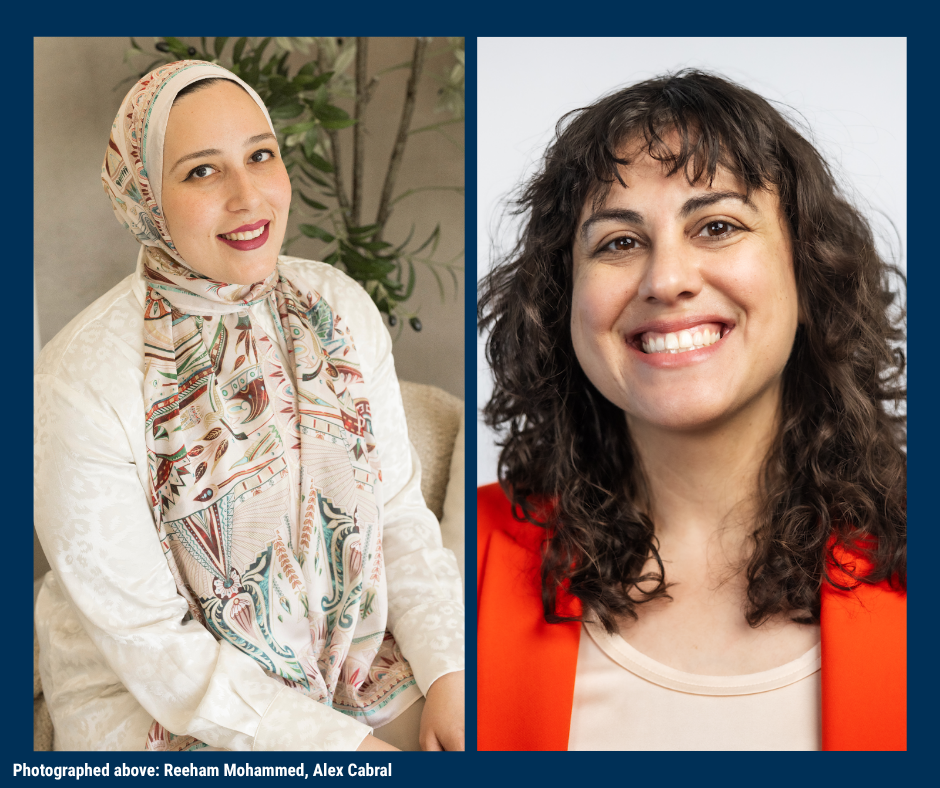
April's Postdoc Spotlight features postdoctoral scholars Reeham Mohammed and Alex Cabral
From monitoring environmental hazards in communities to examining how artificial intelligence (AI) shapes workplace dynamics, two Georgia Tech postdoctoral scholars are exploring how technology intersects with everyday life. Postdoctoral researchers Alex Cabral and Reeham Mohammed approach their work from different angles, but both are driven by a shared commitment to understanding and improving systems that shape how people live, work, and interact with the world.
From monitoring environmental hazards in communities to examining how artificial intelligence (AI) shapes workplace dynamics, two Georgia Tech postdoctoral scholars are exploring how technology intersects with everyday life.
Postdoctoral researchers Alex Cabral and Reeham Mohammed approach their work from different angles, but both are driven by a shared commitment to understanding and improving systems that shape how people live, work, and interact with the world.
Paths Leading to Georgia Tech
For Alex Cabral, a postdoctoral fellow in the School of Interactive Computing, coming to Georgia Tech was a strategic step toward the academic career she had long envisioned: becoming a professor and conducting her own research lab.
Before earning her PhD, Alex worked as a Software Developer at Xbox, a middle and high school Computer Science, Math, and Robotics teacher, and a curriculum developer. Alex then completed her doctoral work at Harvard University, where she focused on designing reliable, representative, and equitable urban environmental sensor networks. For the next step in her career, Alex was drawn to Georgia Tech’s expansive computing community and collaborative environment and sought out mentorship opportunities, potential collaborators, and research labs that would deepen her research expertise and teach her how to lead a lab of her own. At the recommendation of respected colleagues, Alex reached out to Josiah Hester, Associate Professor at the School of Interactive Computing, and discovered through a research visit that there was “exciting overlap” in their work. She now works as a postdoctoral fellow in the Ka Moamoa Lab and is an incoming faculty member at Massachusetts Institute of Technology.
Reeham Mohammed’s path reflects both intellectual curiosity and a desire to expand the impact of her research. Originally from Egypt, she completed her master’s degree at the University of Nevada, Reno, and then obtained her PhD in interdisciplinary communication studies with a focus on organizational communication, human-machine interaction, and artificial intelligence (AI), from Arizona State University. “I chose that field because of my deep belief that communication is key to understanding society as a whole, including all the interactions that are happening between humans and technology,” shares Reeham.
Her quest to find opportunities to extend her research led her to Georgia Tech’s School of Public Policy, which offered the perfect environment to explore how artificial intelligence is shaping workplace experiences, specifically in manufacturing settings.
Research that Meets the Real World
Alex’s research intersects with technology, environment, and community. She focuses on developing low-cost sensing devices and digital platforms that help monitor environmental health hazards like air pollution and water quality.
Alex’s background includes working in rural, urban, and Native American communities to design and deploy tools that are accessible and impactful to the respective populations.
On the other hand, Reeham’s research in the School of Public Policy explores how people make sense of emerging technologies like AI, with complex systems. Reeham’s background in interdisciplinary communications studies lends her the ability to bridge organizational communication, human-machine interaction, and public policy.
Reeham’s current research examines how AI is being integrated into manufacturing workplaces, focusing on how employees interpret, adapt to, and shape these technologies. Her research emphasizes how people make sense of AI in everyday practice and what they identify as necessary conditions for responsible and equitable implementation.
A Day in the Life of a Postdoc
Alex spends much of her time mentoring students, collaborating with partners, and continuing research through grant writing and development. Her role often places her in an advisory position, where she hones her leadership skills to develop people and projects.
Colleagues describe her as deeply committed to using technology in innovative ways to support marginalized communities and empower them to take ownership over their livelihoods. Despite managing multiple projects simultaneously, she brings a consistent level of energy, enthusiasm, rigor, and intellectual curiosity to her work, making her both a valued collaborator and an exceptional postdoctoral scholar.
“On a non-typical day,” shares Alex, “I may be kayaking to access waterborne sensing devices, giving a talk halfway around the world, or participating in a community event.”
Reeham’s days are similarly dynamic. She spends time in meetings and discussions, conducting interviews, reviewing literature, and attending campus events. Her work requires analytical depth and an ongoing dialogue with evolving ideas and perspectives.
Life Beyond the Lab
Life is invigorating outside of the lab. For Reeham, relocating from Arizona, where she saw plenty of cactuses and desert life, to Atlanta, where lush trees and greenery are plentiful, makes her “happy.” She previously trained in kickboxing as a way to support her mental and physical well-being and hopes to return to it soon. Reeham is also multilingual; she speaks English, French, Dutch, Spanish, Hausa, and her mother tongue, Arabic.
Alex enjoys exploring Atlanta, visiting the Buford Highway Farmer’s market, or attending an Atlanta Hawks game. She is also the proud owner of a calico cat appropriately named “Peaches.” “Clearly, she was meant to be here (in Georgia)”, she quips.
Even with differing research areas, Alex and Reeham share a common commitment to ensuring that technology serves people in thoughtful and meaningful ways.
Whether through designing tools that empower communities to monitor their environment or examining how AI reshapes human experiences in the workplace, their work reflects the evolving role of research in addressing real-world challenges.
Alex and Reeham both represent the depth, diversity, and impact of Georgia Tech’s postdoctoral community. Here, innovation isn’t just about advancing technology; it’s also about understanding and improving the human experience.