
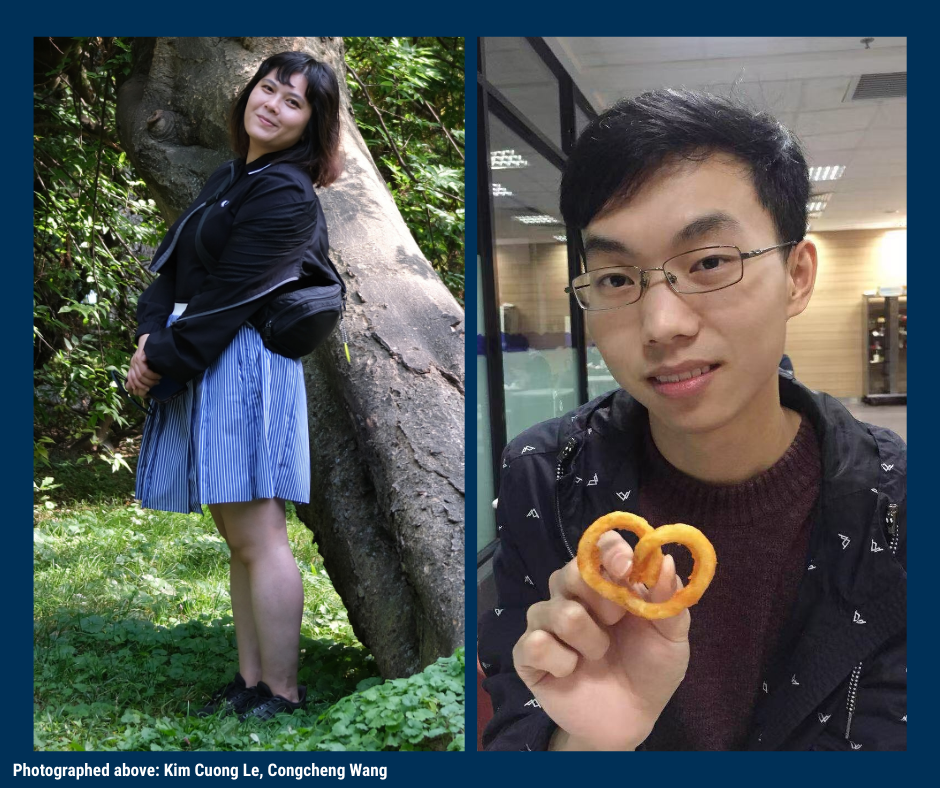
This month's postdoc spotlight features two researchers from the School of Mechanical Engineering, Kim Cuong Le and Congcheng Wang
This month’s Postdoc Spotlight features Kim Cuong Le and Congcheng Wang, two postdoctoral scholars from Georgia Tech’s School of Mechanical Engineering whose impactful research and collaborative leadership are advancing the field and strengthening the research community.
Georgia Tech’s postdoctoral scholars play a critical role in advancing research that addresses some of the world’s most pressing challenges, from clean energy to advanced materials to sustainable agriculture and forestry. This month, we highlight Congcheng Wang and Kim Cuong Le from the George W. Woodruff School of Mechanical Engineering, whose work reflects the interdisciplinary thinking and real-world impact that define research at Tech. Although Wang and Le’s research areas differ, their work contributes to Georgia Tech’s research enterprise.
Together, their stories highlight how mechanical engineering at Georgia Tech extends far beyond traditional boundaries, fostering innovation across energy systems, materials science, and plant biotechnology.
Engineering Better Batteries for the Future
Postdoctoral fellow Congcheng Wang’s research aims to understand and engineer materials for energy storage, with a focus on investigating the structural evolution of electrodes in high-performance batteries.
“Batteries enable portable electronics, robots, and electric vehicles,” Wang explained. “I work on battery materials to increase energy density, safety, and lifetime, which could support better renewable energy systems, transportation, climate goals, and everyday technology.”
Wang earned his bachelor’s degree in Materials Science and Engineering from Zhejiang University and his Ph.D. in Mechanical Engineering from the Hong Kong University of Science and Technology. His path to Georgia Tech was shaped by collaboration; while working with a talented Tech undergraduate during his Ph.D. studies, the student recommended Tech. Wang then applied for the postdoc position in Professor McDowell’s lab, ultimately joining his team.
In addition to his research focus, Wang is widely recognized by his colleagues for both his productivity and his generosity as a collaborator. Over the past year, he has authored four first-author publications, including work published in Nature Materials, and has made significant contributions to several additional papers. These achievements are matched by his reputation as a thoughtful teammate. Colleague and nominator Douglas Nelson, described Wang as someone who asks insightful questions, readily supports others’ research, and approaches collaboration with warmth and humility.
As an experimental researcher, Wang’s days are both flexible and demanding. He spends much of his time conducting experiments, analyzing data, reviewing literature, and engaging in discussions with collaborators. Outside the lab, he enjoys rock climbing, a hobby that combines physical endurance and mental problem-solving. When it’s time to unwind, one of his favorite places in Atlanta is the Georgia Aquarium. “I feel very relaxed seeing those aquatic animals in the water,” Wang reflects.
Advancing Sustainable Plant Technologies Through Engineering
Kim Cuong Le also conducts her postdoctoral research within the School of Mechanical Engineering, but her work focuses on the opposite side of the engineering spectrum. Le’s work specializes in bioreactor technology and automation systems for plant tissue culture, with a focus on large-scale propagation and process optimization.
With more than a decade of experience in plant biotechnology, Le specializes in large-scale plant tissue culture, somatic embryogenesis, and process optimization for sustainable propagation systems.
Her passion for plants began early. Growing up in a highland city in Vietnam surrounded by flowers, vegetables, and pine forests, Le developed a natural curiosity about plant life that shaped her academic path.
“Being surrounded by mountains and greenery every day made plants feel like a natural part of my life. That environment is what made me fall in love with plants and inspired my curiosity to understand them more deeply,” said Le.
Le completed her undergraduate and master’s research at the Tay Nguyen Institute for Scientific Research, before earning her Ph.D. at Chungbuk National University in South Korea, where she trained under global leaders in large-scale bioreactor systems for plant production.
That foundation led her to Georgia Tech, where she now works with Professors Cyrus Aidun and Ulrika Egertsdotter on specialized bioreactors and automated somatic embryo fluidic systems. The work that she is currently doing possesses significant potential for forestry and the paper industry.
Beyond her technical expertise, Le is also known for the way she shows up for others in the lab. Her colleague, Chaitanya Nayak, mentioned that her expertise in the field of research is complementary to hers, making her a great collaborator and someone whom she intends to learn a lot from. Nayak also shared that Le “should be recognized for both her upkeep on academic and general personal relationship-building with everyone on her team.”
When asked about a typical day as a postdoc at Georgia Tech, Le shared that she spends her time planning experiments, checking results, and working closely with students, other postdocs, and professors.
"Every day is a mix of research, teamwork, and learning, which is what makes the role both challenging and rewarding,” said Le.
When she is not in the lab conducting research, Le enjoys nature photography, reading, and collecting cooking recipes to try at home. Her favorite places in Atlanta reflect her love and passion for nature: the Atlanta Botanical Garden and Piedmont Park, where she and her husband enjoy walking and running together. Georgia Tech also holds personal significance for Le, as it’s where she met her husband.
One School, Many Paths
Though Wang and Le study vastly different systems, batteries and plants, their work reflects a shared mission rooted in mechanical engineering principles, systems thinking, and sustainability. Both are driven by the belief that research should extend beyond the lab to create tangible benefits for society.
Their stories underscore the interdisciplinary strength of the George W. Woodruff School of Mechanical Engineering, where postdoctoral scholars are empowered to push boundaries, collaborate across fields, and contribute to a more sustainable future.