
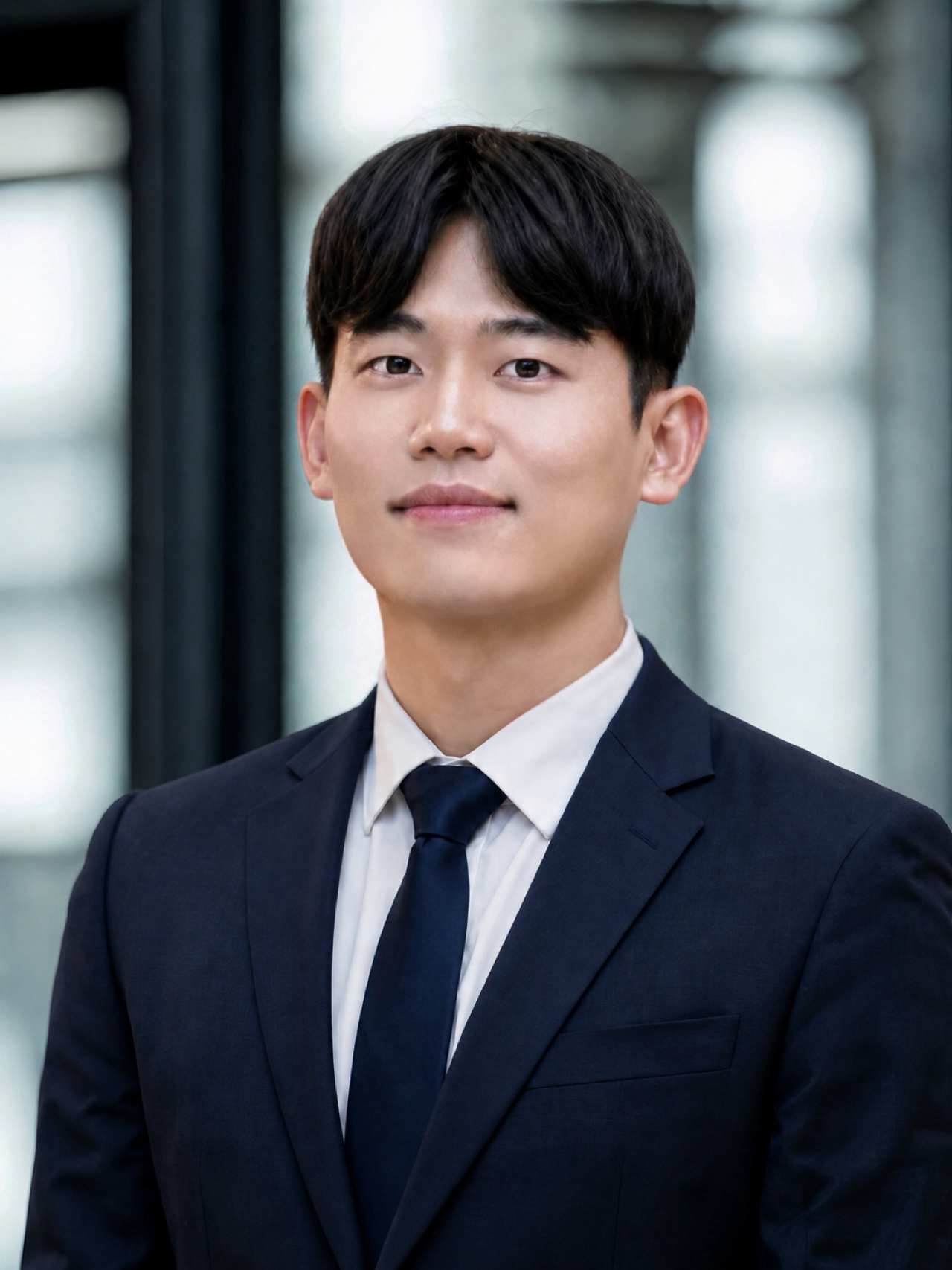
Postdoctoral researcher Suyoung Park develops AI-driven approaches to help manufacturers evaluate suppliers, strengthen production networks, and respond to disruptions.
From artificial intelligence to industry partnerships, Suyoung Park is helping manufacturers rethink how they choose suppliers, solve problems, and adapt to change.
Suyoung, a postdoctoral fellow in the George W. Woodruff School of Mechanical Engineering, focuses on cyber manufacturing and develops AI methods to better evaluate suppliers' manufacturing capabilities across production networks.
He earned his Ph.D. in mechanical engineering from Seoul National University in South Korea, where he researched smart factories, robotic automation, digital twins, and monitoring systems for complex industrial environments. His long-term research goal is to develop methodologies for evaluating the capabilities of robotic systems used in manufacturing. By making these capabilities measurable and comparable, his work supports more responsive, resilient, and automated production networks.
Currently, manufacturers choose suppliers based on factors such as reputation, delivery performance, and financial stability. While these factors are important, they don’t accurately determine whether a supplier has the manufacturing systems needed to produce a specific product.
During his Ph.D. studies, Suyoung realized that advancing supplier selection technology alone was not enough. He works to address this gap by developing quantitative, data-driven AI methods to assess "the capabilities of manufacturing processes, suppliers, and automation technologies at the product and task levels."
This type of work has been especially relevant during recent supply chain disruptions like the COVID-19 pandemic, semiconductor shortages, and geopolitical uncertainty. If an existing supplier suddenly fails to deliver an essential product, it can be hard to find alternative suppliers that can produce the product needed quickly.
Suyoung hopes to create a stronger supply network for small and medium-sized manufacturers by developing AI methods to help choose the right suppliers that address their needs.
Coming to Tech
Near the end of his Ph.D. studies, Suyoung searched for an environment where he could "move beyond the development of individual smart-factory technologies and address broader, system-level manufacturing challenges." He had an idea of what he wanted to do, but according to Suyoung, “the field was still emerging, and its core concepts and methodologies were not yet clearly established.”
He learned about Professor Shreyes N. Melkote's research group and how they were working towards this direction in cyber manufacturing. Melkote’s research group had a clear research philosophy and vision, and Suyoung wanted to contribute to this research area while the framework was still being developed.
Life as a Postdoc
What does developing data-driven AI methods to evaluate manufacturing processes and technologies look like? According to Suyoung, it looks like "defining research problems, developing computational frameworks, constructing datasets, building and testing AI models, and analyzing the results."
Suyoung also works with industry collaborators to solve real-world manufacturing problems. In a research collaboration with Siemens, Suyoung serves as a co-principal investigator for a research team that monitors processes and detects abnormal operating conditions. He coordinates research activities with students and industry collaborators and helps translate industry-specific requirements into research tasks.
In addition to his industry collaborations, Suyoung mentors undergraduate and graduate students. His work varies day to day; his daily tasks include research planning, AI model development, and physical experiments, as well as student mentoring, project coordination, manuscript preparation, and proposal writing.
Beyond the Research
Suyoung shared that he had no idea how to cook before moving to the United States. Out of necessity, he followed online recipes. He was surprised that he could easily find ingredients from around the world that were hard to find in Korea and experimented with many different cuisines. He initially followed recipes strictly but became "more interested in understanding how ingredients respond to different cooking methods." He paid close attention to how heat and cooking time can affect ingredients' texture, aroma, and flavor.
Before Suyoung moved to the United States, he believed Korean food would be his favorite. His innovative modifications and creations led him to hardly have Korean food these days!
Living in Atlanta
In his free time, Suyoung enjoys going to Dave & Buster's. "I probably take the ticket-collecting part more seriously than I should, but that is what makes it fun."
His favorite place to eat near campus is Pelicana Chicken. He cites it as the “best restaurant in Atlanta.” Even setting aside my familiarity with Korean food, I think the quality of the chicken itself is simply on another level. It may sound unusual to call a Korean fried chicken restaurant the best restaurant in Atlanta, but I stand by that opinion,” he claims with conviction.
Suyoung is working to strengthen supplier networks for small and medium–sized manufacturers that contribute to a more robust manufacturing ecosystem. He exemplifies the efforts of Georgia Tech’s postdoctoral and broader community to advance technology and improve the human condition every day.