
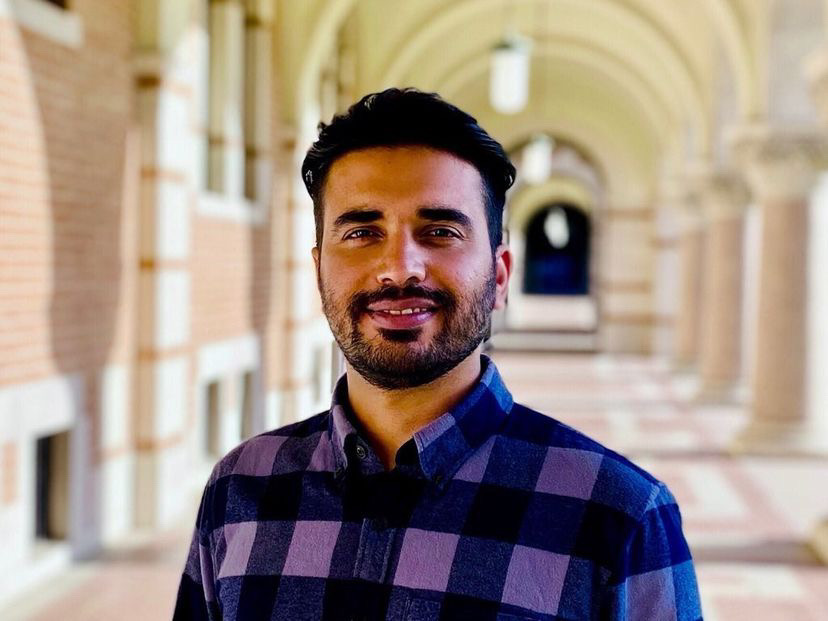
Postdoctoral scholar Sadjad Arzash pictured above
Postdoctoral fellow Sadjad Arzash is investigating how living tissues sense, respond to, and “remember” mechanical forces, using theoretical and computational approaches at the intersection of physics and biology. His work focuses on how simple cell-to-cell interactions give rise to complex tissue behaviors, with implications for morphogenesis, healing, and adaptive materials. Now at Georgia Tech, Arzash continues to advance research that could inform future innovations in medicine and bioengineering while contributing to a deeper understanding of living systems.
Sadjad Arzash is exploring how living systems learn, adapt, and ultimately reshape themselves. As a postdoctoral fellow in the College of Sciences, his work brings together theory and computation to better understand the dynamics of living tissues.
Sadjad investigates how living and soft materials store what is known as “mechanical memory,” the idea that tissues can “remember” past forces and experiences. His research focuses on how living tissues change shape, respond to mechanical force, and acquire new behaviors over time. Working at the intersection of theoretical and computational soft matter physics and biophysics, he studies how local cell-to-cell interactions can give rise to large-scale tissue behaviors, particularly during processes like morphogenesis. His work is driven by a broader question: how can living systems be trained or guided to achieve targeted responses? By understanding how tissues adapt to past experiences, Sadjad aims to uncover principles that could one day inform advancements in health, medicine, and bioengineering.
Sadjad investigates how living tissues sense forces, adapt to them, and even “remember” them over time. This matters because these physical responses help determine how biological tissues grow, heal, and function, and understanding them could eventually inform medicine, bioengineering, and the design of adaptive materials. A major focus of his research is morphogenesis, the process by which cells move, reorganize, and change shape to build the structures of a living organism. What makes this process so remarkable is that living tissues are not shaped the way we shape most everyday materials: if we want to make a beautiful clay sculpture, an artist has to mold it by hand from the outside. In living systems, by contrast, there is no outside sculptor guiding each step. Instead, cells interact locally with one another, and those local interactions can collectively generate complex, functional forms. Using physics-based theory and computer simulations, Sadjad investigates how these simple local interactions give rise to large-scale tissue behaviors, with the broader goal of understanding how living systems can develop targeted properties and responses—and how those same ideas could help inspire the design of novel bio-inspired materials.
The Road to Georgia Tech
After completing his Ph.D. in chemical and biomolecular engineering from Rice University in 2021, Sadjad pursued postdoctoral research jointly at Syracuse University and the University of Pennsylvania, where he continued developing his interdisciplinary approach to soft matter physics and biophysics. He joined Georgia Tech in 2025, drawn by its strong community in physics and living systems.
“Georgia Tech was the natural next step for me because it offers an exceptional environment for soft matter, biophysics, and interdisciplinary physics,” he shares.
His interests, centered on understanding biology through the lens of learning and adaptation, aligned strongly with Georgia Tech’s Physics of Living Systems (PoLS) community, an NSF-funded interdisciplinary program that studies biology through a physical framework.
“I was drawn by the opportunity to work with Professor Shiladitya Banerjee, whose research has a strong overlap with my own interests in how cells and tissues move, respond to forces, and organize into larger patterns and behaviors,” shares Sadjad.
Reflecting on his decision to continue his research at Georgia Tech, Sadjad describes the Institute as “a vibrant and collaborative place,” adding that Atlanta has been a “wonderful city to live in” while building this next stage of his research career.
Life Outside the Lab
A typical day for Sadjad blends deep focus with active collaboration. He begins his mornings by skimming recent papers to stay abreast of emerging ideas in tissue mechanics, morphogenesis, and active matter.
“Much of my day is spent developing computational models and testing equations that motivate my research,” he explains.
Beyond individual work, his days are filled with meetings, discussions, and seminars across campus. Sadjad sees great value in these exchanges, noting that conversation is essential for building connections across disciplines and generating new ideas.
Outside of the lab, Sadjad finds balance through movement and exploration. Playing tennis has become one of his new favorite pastimes and serves as a reset after long days of research. He also enjoys long walks and hikes, since he views time in nature as a form of meditation. Local trails like Arabia Mountain provide a peaceful escape, and walks along Atlanta’s Beltline Eastside Trail, as well as visits to Persian restaurants, help him stay connected to the city and his cultural roots.
Through his work and daily routines, Sadjad embodies the spirit of interdisciplinary discovery, bridging physics and biology to better understand how living systems evolve, respond, and adapt. Sadjad is advancing scientific knowledge and contributing to a deeper understanding of the complex and dynamic world of living matter.