
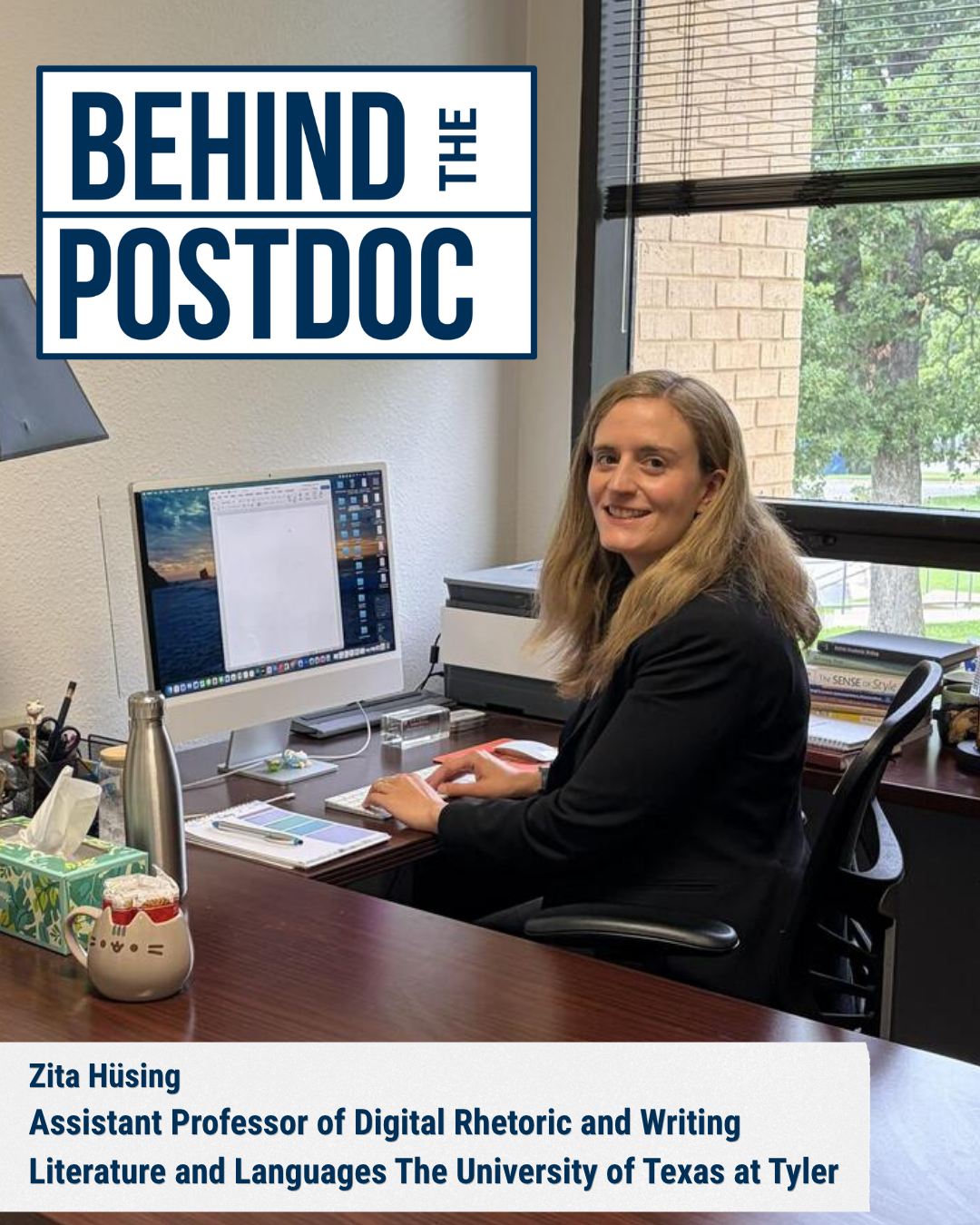
Former Georgia Tech postdoc Zita Hüsing recounts her journey to becoming faculty at UT Tyler while also providing insight for international scholars.
Navigating the job search after a postdoctoral appointment can be intimidating. For international scholars, the process of landing a job is often even more complex, with visa requirements and other employment considerations adding to an already challenging job market.
Zita Hüsing was previously an international Marion L. Brittain Postdoctoral Fellow in the School of Literature, Media, and Communication at Georgia Tech. Today, Zita is a tenure-track assistant professor of Digital Writing and Rhetoric at the University of Texas at Tyler (UT Tyler). The Office of Postdoctoral Services caught up with her to discuss how she navigated the job search, her transition to a new institution, and lessons learned along the way.
Zita began her job hunt after receiving her PhD in 2022. During her postdoc, she resumed her job search for a tenure-track faculty role. In fall of 2023, she focused on completing applications and began virtual interviews during the winter of that year. Then, during the following spring, she traveled for in-person interviews, which ultimately led to her accepting and beginning her current role at UT Tyler in August 2024.
Advice for Postdocs on the Academic Job Market
Because of her international status, Zita only applied to institutions that had experience and established processes in sponsoring employment visas. Once she accepted the position at UT Tyler, university lawyers worked with her to ensure that her visa would be sponsored in time for her start date.
“In retrospect, I would recommend having visa sponsorship or any promises the university makes to you in your offer letter and the contract you’re signing.” She suggests that applicants should maintain communication with Human Resources and university lawyers and reach out to international faculty members to learn about how they navigate the process.
According to Zita, teaching is a nonnegotiable skill for any type of faculty role. For current postdocs, she suggests “Try to get teaching experience. R1, R2, and R3 universities are looking for teaching excellence. Universities are not only looking for great or excellent researchers but for great and excellent teachers as well.”
Lastly, she emphasizes being yourself. If you feel like you don’t fit into the community during an on-campus visit, then it is okay to decline an offer. For Zita, it is more important to find a place where you will get along with colleagues for the duration of your career.
This totally makes sense, as it definitely can feel like we spend more time with our coworkers than friends and family, whether we want to or not. The least we can do is enjoy it.
New Kid on the Block
As a new faculty member, it can be challenging to establish a community or support system.
Reflecting on her time at Georgia Tech, Zita enjoyed being a part of the postdoc community, building friendships, and supporting peers through the job market. She is especially grateful for the mentorship of Dr. Melissa Ianetta, Dr. Andy Frazee, Dr. Lisa Yaszek, Dr. Ida Yoshinaga, and Dr. Allegra Smith.
To create the same sense of community at UT Tyler, Zita attends events to network and make friends and continues to collaborate with postdocs and faculty she met at Georgia Tech. She encourages everyone to put themselves out there while maintaining old connections when starting a new role.
Supporting Students
Learning to balance teaching, service, and research while being a postdoc at Tech allowed Zita to feel better prepared for her transition to UT Tyler. However, all changes come with new challenges and opportunities.
Zita mentions that it takes practice to establish boundaries with students when you genuinely care about them. She supports her students as best she can but also notes, “It’s important... that you don’t take on this nurturing role when you’re not supposed to.” Instead, she encourages future faculty to be aware of resources on campus to refer students who need additional support.
Mentoring graduate students and addressing their needs has been an eye-opening experience. “They think you know it all, (but) I’m also learning as I go along.” As Zita grows in her role as an assistant professor, she has discovered a passion for helping prepare students for potential careers. She now integrates elements of career preparedness into the classroom by encouraging students to reflect on how the knowledge and skills they gain in each course can be applied to their future career goals.
Teaching in the Age of AI
One recent topic Zita has explored with her students is the ethical use of artificial intelligence (AI) in higher education. To help students learn the difference between using AI responsibly to generate ideas and using it to plagiarize, she developed an AI Ethics module that explores the pitfalls of AI and prompts students to reflect on questions such as “Should AI replace human-made art?” and “How can generative AI lead to misinformation?”
Finding Balance Beyond Work
While Zita’s experience at UT Tyler has been rewarding and allows her to focus on research, she finds fulfillment outside of work. In fact, enjoying her private life and taking care of her mental health makes her better at her job. “It can’t just be all work all the time. My students can tell if I’m tired. My students can tell if I’m not passionate, (or) if I don’t want to be there, but they can also tell if you really want to be there.”
Zita enjoys hiking, spending time with her partner, and having weekends off. She emphasizes doing things that are good for your soul.
More on Zita
Zita looks forward to continuing her research and service and striving for teaching excellence at UT Tyler.
You can explore Zita’s work encouraging ethical and responsible use of AI by checking out her online publications' portfolio as well as her faculty page at UT Tyler.
Learn more about the School of Literature, Media, and Communications’ Writing and Communication Program and Brittain fellowship.
To hear Zita's journey to Georgia Tech, check out the Postdoc Visibility Project. You can also find out more about the School of Literature, Media, and Communication.