
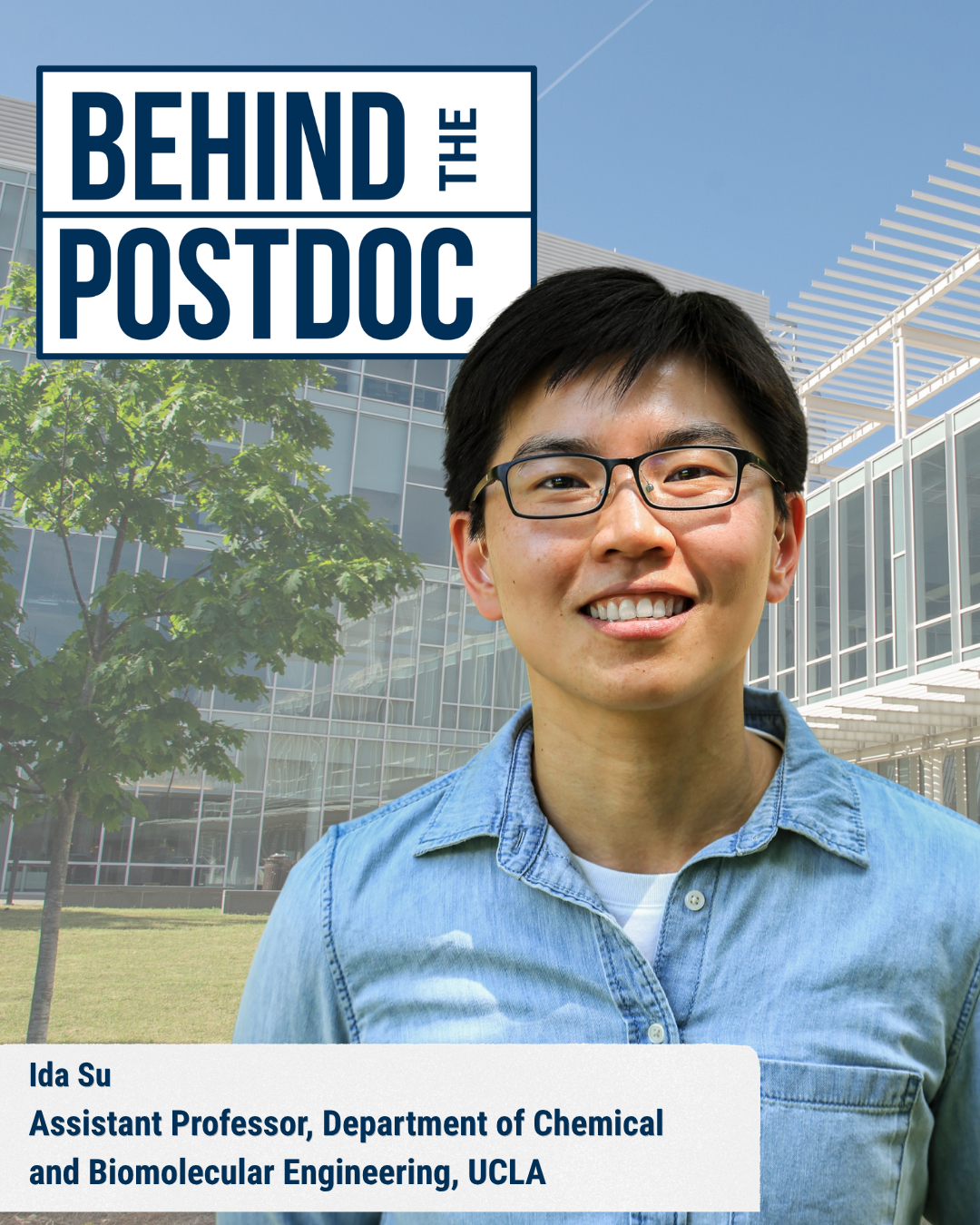
In November 2025, former Georgia Tech postdoctoral scholar Ida Su transitioned to a tenure-track faculty role as an assistant professor in the Department of Chemical and Biomolecular Engineering at the University of California, Los Angeles (UCLA). Ida recently spoke with the Office of Postdoctoral Services to share how she is embracing the opportunities and challenges that come with building a research program, mentoring students, teaching courses, and shaping the next chapter of her academic career.
When we first sat down with Ida, we asked her to highlight her reasons for staying in academia. “What motivated me to pursue a faculty position is the freedom to pursue scientific questions and address clinical problems that I’m excited about,” reflects Ida. “I don’t think that same level of freedom is always available in industry.” Second, Ida genuinely enjoys mentoring students. “I love seeing students grow from not even knowing how to hold a pipette to eventually being able to run entire experiments and complete experiments independently. That process feels very fulfilling to me.” Ida also wanted to stay in academia for the opportunities to attend conferences, exchange ideas with colleagues, and contribute to scientific discovery. Ultimately, her goal is to advance research that improves treatments for diseases such as cancer and autoimmune disorders.
Navigating the Faculty Application Process
We were then curious about how Ida prepared for the academic job search, which she described as a multi-stage journey requiring significant preparation and persistence.
The process typically begins with assembling an application package that includes a research statement and a teaching statement. Of these materials, Ida considers the research statement to be the most critical component because it communicates a candidate’s long-term research vision and future program of study.
Following the application review process, selected candidates are invited to participate in screening interviews, often conducted via Zoom, before advancing to on-site interviews. These campus visits generally include giving a research seminar, meeting with faculty members, and engaging with students and institutional leadership.
While the process can be demanding, Ida emphasizes that persistence is essential.
During her fifth year as a postdoctoral scholar at Georgia Tech, she applied to five faculty positions primarily to gain experience and better understand the application process. Despite not receiving any interviews during that cycle, the experience helped her refine her research vision and strengthen her application materials.
The following year, she applied to 26 institutions. With a stronger research statement, additional data, and a more clearly defined research program, Ida secured nine virtual interviews, advanced to five on-site interviews, and ultimately received offers from each institution she visited.
Looking back, she believes the growth and refinement of her research statement played a significant role in her success. Ida also credits her friends and colleagues, including Professor Leslie Chan in Georgia Tech’s Department of Biomedical Engineering, who provided valuable feedback on her application materials and helped her prepare for interviews.
Similarities and Differences Between a Postdoc and Faculty Position
After arriving at UCLA, Ida had to quickly adapt and noticed both similarities and differences to her role as a postdoctoral scholar. Ida mentions that research remains at the center.
“In terms of similarities, I would say that research is still the biggest one,” recalls Ida.
Forming research ideas, interrogating the process, designing and conducting experiments, and training students are all responsibilities that carried over from her postdoctoral experience at Tech. One major difference has been teaching. “As a postdoc,” says Ida, “I didn’t need to focus much on teaching, but now teaching is a major part of my role – even at UCLA, a research-intensive university.”
Ida notes that teaching takes about 40-50 percent of her time as an assistant professor; preparing course materials takes significant time and effort that she did not have to allocate before.
A Day in the Life
As a faculty member, Ida juggles more than just researching and teaching.
“Every day actually looks different because the responsibilities of an assistant professor include a wide range of tasks,” reflects Ida. At any given time, you might find her setting up the physical lab space, conducting experiments with students, attending collaborative meetings, teaching in the classroom, meeting with potential postdocs and graduate students, and completing other administrative tasks like grant–writing. The variety of work keeps each day interesting and reflects the many hats faculty members wear as researchers, mentors, educators, and administrators.
How Her Postdoctoral Experience Prepared Her for Faculty Life
Ida credits much of her success to the opportunities she received during her postdoctoral training at Georgia Tech. She worked closely with her postdoctoral advisor on grant writing, proposal development, mentoring students, and generating new research ideas—experiences that closely mirrored many of the responsibilities she now manages as a faculty member.
“My postdoc advisor gave me opportunities to experience almost all aspects of being a faculty member,” she says.
She also gained valuable insight into how a research lab grows and evolves. Because her advisor was still relatively early in his faculty career when she joined the lab, Ida was able to observe firsthand how to build research infrastructure, manage budgets, recruit students, and plan for future growth. Those lessons have proven invaluable as she establishes her own laboratory at UCLA.
Prioritizing Well-Being During a Major Transition
While beginning a faculty position has been exciting, Ida acknowledges that the transition has also been challenging. Relocating to a new city, building a support network, learning institutional systems, and balancing numerous responsibilities created a steep learning curve during her first several months.
To support her well-being, Ida prioritizes regular exercise by taking Orangetheory fitness classes, seeks advice from trusted colleagues and mentors, and remains actively involved in her faith community. “Even though there is always more to do, things feel much more manageable now than they did during those first few months,” she reflects.
Advice for Current Postdoctoral Scholars
For postdocs considering their next career move, Ida encourages thoughtful reflection and intentional exploration. She recommends speaking with professionals working in both academia and industry to gain a realistic understanding of what daily life looks like in each career path.
“Think about whether that is the life you want for decades,” she advises.
Though academia offers intellectual freedom, it also comes with its own unique challenges and demands. Understanding the realities of each path can help postdoctoral scholars make informed decisions and find careers that align with their values, interests, and long-term goals. As Ida continues building her research program and mentoring the next generation of scientists, she remains energized by the opportunities ahead and confident that pursuing a faculty career was the right decision.